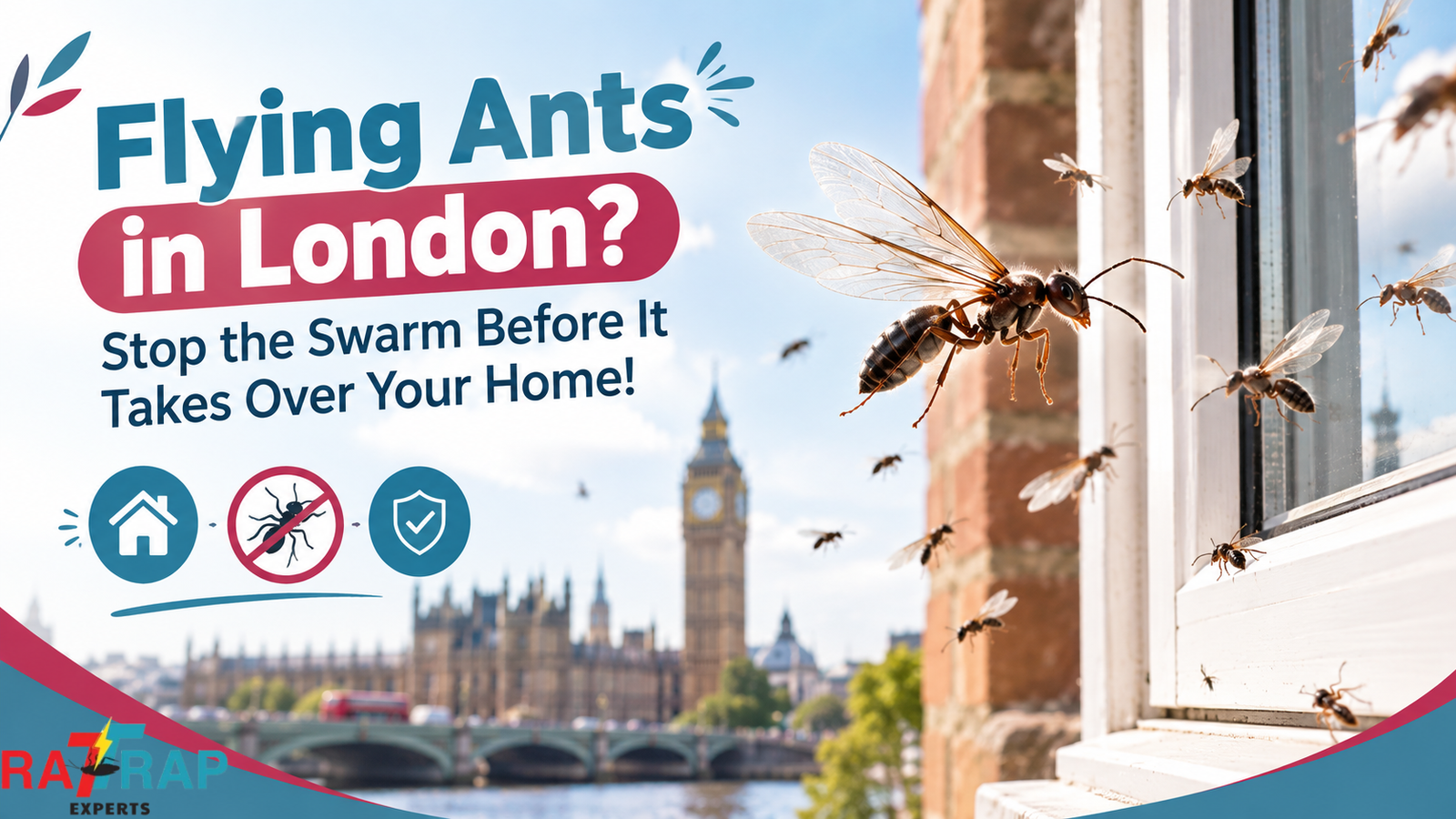
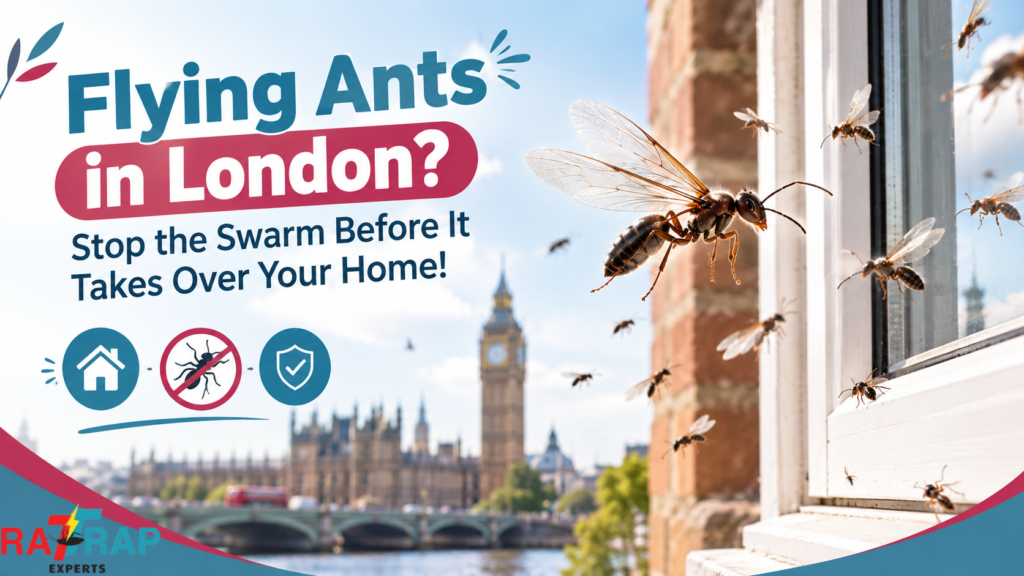
Flying ants in London homeowners see each summer and rainy day are the winged queens and males of common black garden ants (Lasius niger). They leave the nest together on warm, humid days, usually in July and October, to mate. The swarm lasts a few days. To stop flying ants, seal entry gaps, remove food and moisture, and treat the nest underneath, not just the ants you can see.
Key Takeaways
- Flying ants are not a separate species. They are ordinary ants with wings, out to mate.
- Swarms are triggered by warm, humid, still weather, often after rain. That is why a whole street can see them on the same evening.
- Most winged insects found in London homes are ants, not termites. A quick check of the waist, antennae and wings tells you which.
- Flying ants indoors usually mean a nest is close, often under a patio, in a wall cavity or beside the foundations.
- Killing the visible ants helps for the day. Treating the nest is what stops them coming back next year.
What Are Flying Ants?
You step into the garden on a warm evening and the patio is suddenly alive. Hundreds of small winged ants are crawling, lifting off, landing on your arms and drifting towards the kitchen light.
Flying ants are the reproductive members of an ant colony: young queens and males. In the UK, most of the swarms you see in London gardens come from the common black garden ant, Lasius niger. The workers you see on your patio all year round never fly. Once a year, the colony grows a batch of winged ants and sends them out in one coordinated burst called a nuptial flight.
If flying ants become a problem at your home or business, Rat Trap Experts provides emergency pest control in London to help identify the issue and recommend suitable treatment.
Why Do Flying Ants Appear in London?
They are looking for a mate, and the weather tells them when to go.
Here is what is going on:
- The colony is mature. After a few years, a healthy nest produces winged queens and males.
- The weather is right. Warm, humid, calm conditions, often right after rain, give the ants the best chance of flying safely.
- Everyone goes at once. Colonies across the area release their ants at the same time, so queens can meet males from other nests and avoid inbreeding.
- The ants mate, then the males die. Fertilised queens drop their wings and look for a spot to start a new colony. Many find it in soil, under paving slabs or in gaps around your property.
Built-up parts of London hold heat well, so swarms can start earlier or hit harder in sunny, sheltered gardens and courtyards.
When Is Flying Ant Day in London?
There is no single official date for Flying Ant Day in London. Flying ants usually swarm when weather conditions are suitable, particularly during warm, humid periods after rainfall. Although swarms are more common in summer, occasional activity can occur outside the peak season if conditions allow. Pest Control in Dagenham might experience a swarm while Hornchurch sees little activity, as timing varies between locations.
Swarms are big enough that weather radar can pick them up, which is why the Met Office has been known to mention them. If you want to know what the weather is doing, check the forecast at the Met Office. Hot, humid, rainy and still is the pattern to watch for.
Flying Ants vs Termites: How to Tell the Difference
Worried you might be looking at termites? Good news: termites are not an established pest in London homes. Almost every winged insect you find indoors is a flying ant. Here is how to be sure.
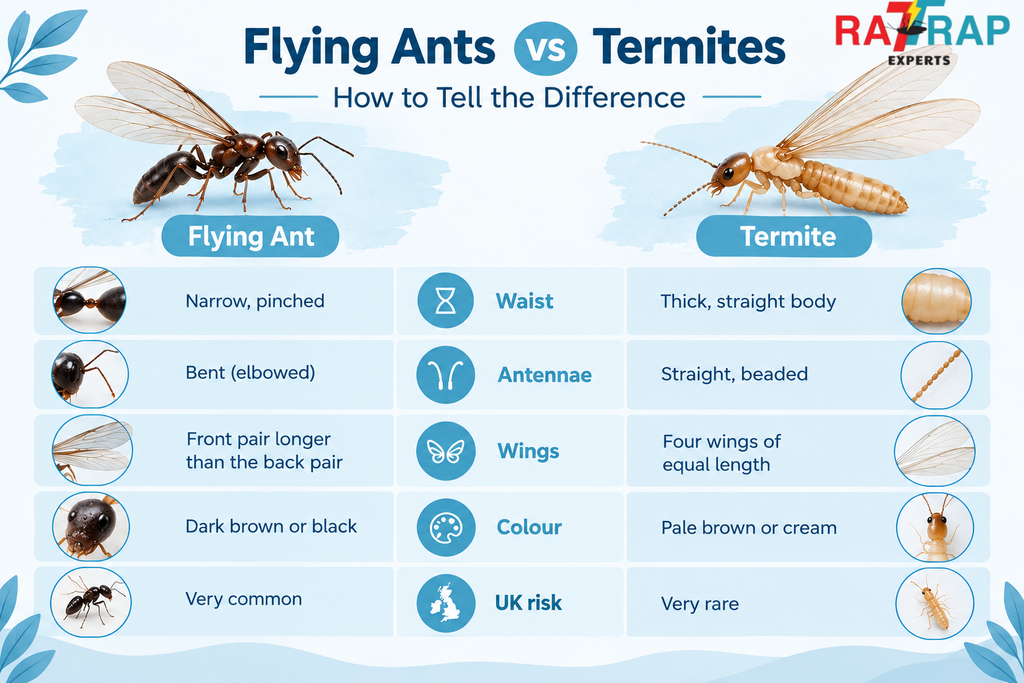
Still not sure? Take a clear photo and send it to us on WhatsApp. We will tell you what it is.
Are Flying Ants Harmful?
Mostly, they are a nuisance rather than a danger. They do not spread disease the way rats or cockroaches can, and the winged ants rarely bite. A few worker ants can nip if you disturb them, but it is mild.
The real issue is what flying ants tell you:
- A nest is nearby. Colonies under patios and paving can loosen the sand beneath slabs.
- Ants can find your food. Once workers learn there is sugar or crumbs in the kitchen, they keep coming.
- They are unpleasant. Swarms in bedrooms, on windowsills and around lights are no fun, especially if you run a restaurant, shop or salon.
Why Are There Flying Ants in My House?
If you have flying ants indoors, one or more of these is usually the reason:
- A nest sits close to the building, in the foundations, cavity walls or under a nearby patio.
- Tiny gaps around window frames, door thresholds, airbricks and pipe entries give them a way in.
- Lights act like a beacon. Winged ants are drawn to bright windows at dusk.
- Damp, warm spots such as leaky pipes, bathrooms and kitchen corners attract workers all year.
- Unsealed food, pet bowls and sticky spills tell scouts there is a meal on offer.
If the ants emerge from inside a wall, a skirting board or a kitchen cabinet, the nest may be inside the property. That is the point to call a professional rather than reaching for the spray.
How to Stop Flying Ants: 7 Steps That Work
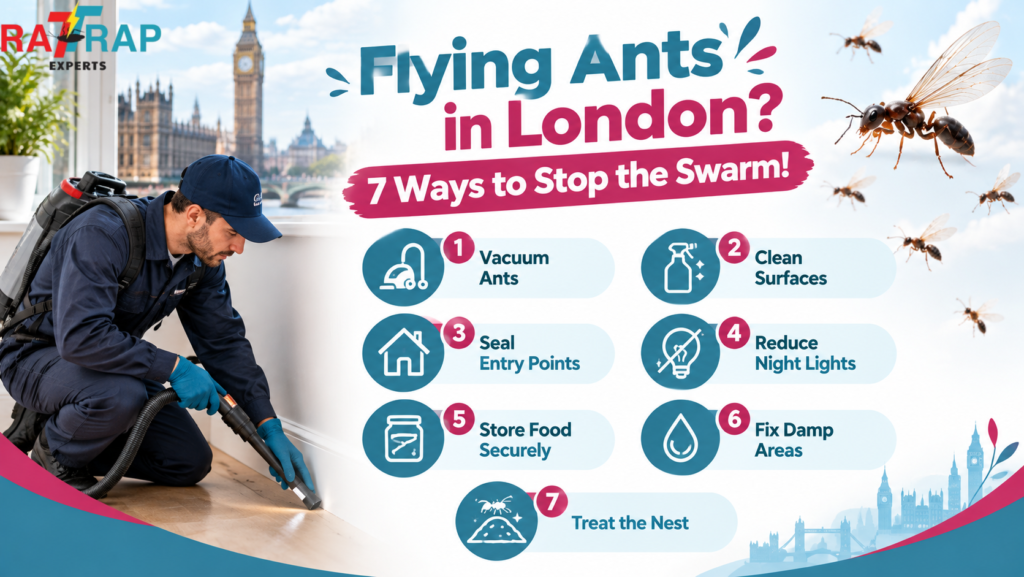
- Vacuum the swarm. It is quick, clean and effective for the ants already indoors. Empty the bag or bin outside straight away.
- Wipe surfaces with soapy water. It breaks up the scent trails workers follow. Skip strong sprays near food prep areas.
- Seal the entry points. Use flexible sealant around window frames, door edges, cracks in brickwork and pipe gaps.
- Switch off lights near open windows at dusk. Draw curtains during swarm evenings and keep doors closed.
- Clear food sources. Store sugar, honey and pet food in airtight containers and take out the rubbish regularly.
- Fix damp and leaks. Dry, tidy spaces are less attractive to ants.
- Find and treat the nest. Follow trails of workers back to the source. Nests in walls, under slabs or in foundations are best treated by a professional.
What Not to Do
- Don’t just spray the swarm. It clears today’s ants but does nothing for the colony that sent them.
- Don’t pour boiling water near foundations or patio edges. It rarely reaches the whole nest and can damage plants and mortar.
- Don’t ignore it if it comes back every year. Repeat swarms in the same spot mean the nest is still there.
DIY or Professional Ant Control?
If you spot a handful of ants, tidy up and seal gaps and you will probably be fine. Call a professional when:
- Ants keep returning after you have cleaned and sealed
- You can see steady trails or emerging ants indoors
- The nest is in a wall, under a patio or near your foundations
- You run a business and need a fast, discreet fix
- Children or pets are around and you want a safe, targeted treatment
At Rat Trap Experts, our technicians trace the nest, use treatments suited to your property and explain what they are doing, step by step. You can read about our full ants and insects control service or see how we handle ant pest control in Dagenham.
Flying Ant Control Across East & North London
Our office is in pest control Dagenham, and we cover homes and businesses in Romford, Ilford, Hornchurch, ant control in Barking, Upminster, Stratford, Islington and surrounding postcodes. Same-day visits are often possible for urgent cases, and we back our work with a pest-free guarantee.
Frequently Asked Questions About Flying Ants in London
Why do I get flying ants in my house?
Flying ants come indoors when a nest is close by and they find gaps, lights or food. They are drawn to bright windows in the evening and slip in through small cracks around frames, doors and pipes.
How long do flying ants last?
A swarm usually lasts a few hours to a couple of days. The season of swarms can run through July, August, September and October as different colonies react to warm, humid spells.
Do flying ants bite?
Winged ants rarely bite and are not dangerous. Worker ants can give a mild nip if disturbed, but flying ants are mainly a nuisance.
How do I get rid of flying ants quickly?
Vacuum them up, wipe the area with soapy water, seal gaps and close windows and curtains at dusk. For a lasting fix, the nest has to be treated, and that is a job for a professional.
Are flying ants a sign of termites?
No. In London, winged insects in homes are almost always ants. Ants have a pinched waist, elbowed antennae and unequal wings. Termites have a straight body, straight antennae and equal-sized wings.
Does Rat Trap Experts treat flying ants in my area?
Yes, Rat Trap Experts provides professional pest control services across Dagenham, Romford, Ilford, Hornchurch and wider East and North London.
Don’t Let Flying Ants Take Over Your Home or Business
A few flying ants are part of a London summer. A swarm in your kitchen, bedroom or shop is a different matter. Our local team is ready to find the nest and fix it properly.
Call +44 7405 971300 for a quick, friendly quote, or follow Rat Trap Experts on Instagram to see our real pest control work and results